
To celebrate International Women’s Day, the Embassy of China in the Netherlands and China Cultural Centre Den Haag hosted a special event about Chinese Kun Opera for a group of international women. The beautiful photo exhibition on Kun Opera will last till the end of March 2018. Floating Feather was honoured to give a special guided tour and would like to share a brief overview of Kun Opera in this article.
Chinese Kun Opera is one of the oldest and most refined styles of traditional Chinese theatre performed today. It is the origin of all Chinese operas. According to the Western and oriental definition of art form, Kun Opera can be seen as a combination of drama, opera, ballet, poetry recital, mime, farce, and more forms of art. Some of these art forms go back to the third century B.C. or even earlier. Kun Opera came into existence when a group of people gathered on the street and started making their own songs and plays.
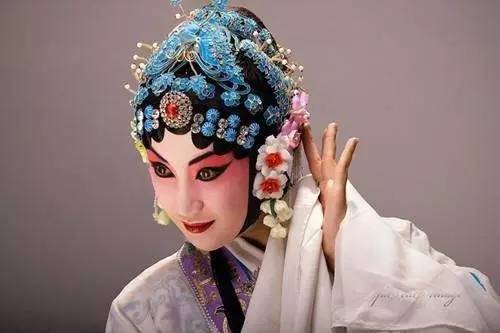
Characteristics of Kun Opera
Stylised movement or gestures with an emphasis on elegance for women
Each word or phrase in a Kun Opera is strictly expressed by a stylised movement or gesture. Even casual gestures must be precisely executed and timed to coordinate with the music and percussion.
Texts, Dance and Music are equally important to the play
In a Kunqu performance, texts, dance and music form three essential media. They work in harmony to convey the meaning and desired aesthetic effect of the playwright. An accomplished Kun Opera performer must master the special styles of singing and dance movement at the same time.
Qupai principle: tones, words and melody go hand in hand
“Kunqu music is based on the “Qupai ” principle. Since Chinese is a tonal language, there is a delicate relation between words and tunes. With a wrong tone, the word means something completely different. Since every word has its own “melody”, and the music parts must be layered on the words, without interfering with it. The libretto must conform to the pattern of the particular “Qupai” in regard to the number of lines, the number of syllables per line, tonal sequence and rhyme. Only after the main and subordinate Qupai were selected did the author begin to compose the libretto to match the musical structure.”
-Charles Wilson & Hans Franke
That is also why the Kun Opera playwright is almost always a poet who masters high-level Chinese literature and poems.
Roles of Kun Opera
Sheng, Dan, Jing, and Chou are the four main types of roles in Kun Opera. Dan includes all female roles, and Jing is the one who includes the most sophisticated facial makeup. Each character in the famous play has their own specific makeup. The meanings of the colours are specific in Kun Opera, e.g. red means loyal and white means evil.
Kun Opera orchestra
The Kun Opera orchestra consists of two groups, the Wen Chang and the Wu Chang. The small instrumental ensemble usually consists of 6-10 musicians. Wen Chang group accompanies the singing part, and the Wu Chang group corresponds with the beats and the tempo. The latter group consists of all drum-related instruments.
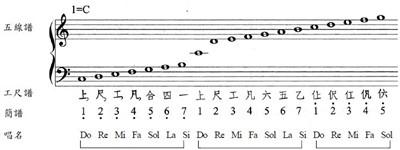
Kun Opera’s music notation methods (in comparison with the Heptatonic scale)
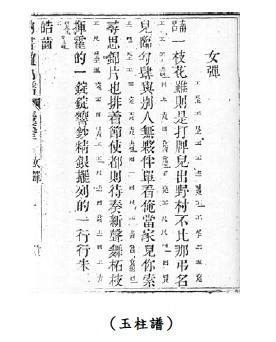
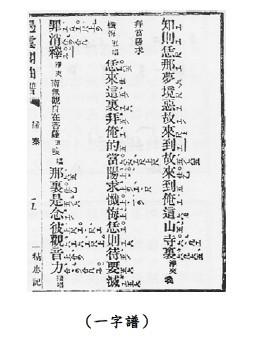
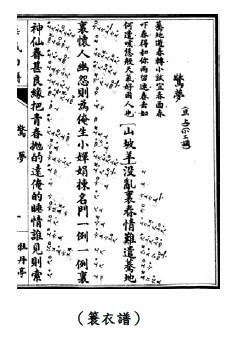
Kun Opera has its own music notation method. In general, there are three methods. They are Yuzhu Pu, Yizi Pu and Suoyi Pu. Yizi Pu is easier for the musicians to read than the other two forms. Depending on the time before or after its standardisation by Master Wei Liangfu in the 16th Century, Kun Opera has either five or seven pitches. The latter one is very similar to the seven pitches in the modern music world. In these 7 varieties, Kun Opera uses Chi, Gong, Fan, Liu, Wu and Yi (尺、工、凡、六、五、乙) to represent the notes which correspond with Do, Re, Mi, Fa, So, La, and Si that we know now. (See picture below) It also has other signs, such as the inhale sign.
A bit of history
The first trace of Kun Opera goes back to the 14th Century (Yuan Dynasty). The Kunshan (Kun Mountain) area in Suzhou in modern Jiangsu Province is the cradle of Kun Opera. The language used in Kun Opera is neither the dialect from Kunshan nor Mandarin. It has its own unique “language”. Master Wei Liangfu standardised Kun Opera’s tunes, tones, rhythms, and pronunciations in the 16th century. Then it was possible for this type of regional art form to become a national one. In the following 200 years between the Ming Dynasty and the Qing Dynasty, Kun Opera became very popular throughout China. And it was loved by some emperor who adopted it into their palace and became the most prestigious drama form in China.
The Kun Opera has suffered a gradual decline since the 18th century because of the high-level technical knowledge it also requires from its audience. And also because of the passing away of a talented opera playwright, Kunqu troupes experienced a commercial decline in the late 19th century. With the rise of other operas, such as Beijing Opera, which also brought in exciting acrobatics, Kun Opera started to lose its ground. The ban on the practices of Kun Opera by an emperor from the Qing Dynasty made it almost impossible for people to practice or to inherit it. As a result, it slowly lost its public base as well. In the 20th century, the Cultural Revolution in China banned all forms of art, which almost led Kun Opera went distinction. Thanks to overseas Chinese Kun Opera groups and enthusiasts, some Kun Opera pieces and techniques survived.
In the recent 40 years, the rise of “zhe zi xi” (arias/selected scenes) has kept this type of art form alive. Instead of performing the whole piece of one play for multiple days, now the artists can perform one or multiple interesting pieces independently. In 2001, Kun Opera was selected as one of the ten “Oral and Intangible Heritage of Humanity” of the world by UNESCO. The 6 troupes in China and more and more young Kun Opera enthusiasts are joining the force of keeping this art form alive. It is important sources of Chinese history, literature, music and aesthetics for the coming generations to treasure.